The Israel Association of Nurse Practitioners (IANP) was founded by a group of nurse practitioners who saw a growing need for unity, professional support, and a shared national voice. Although the NP role in Israel is developing rapidly and is currently the fasted growing sector of health care providers, it has remained fragmented — with practitioners working in isolation, lacking a recognized framework that reflects their clinical capabilities and the essential contribution they make to patient care.
We created the IANP to bring nurse practitioners together under one roof, to strengthen the profession, and to ensure that patients across Israel receive high-quality, accessible, continuous care from clinicians trained to support the full spectrum of health needs — from prevention and early detection to complex chronic disease management.
We aim to work constructively with healthcare leaders, policymakers, and professional communities to advance the NP role in a way that is thoughtful, evidence-based, and aligned with the needs of the Israeli population.
Nurse practitioners provide a unique blend of clinical expertise, continuity, whole person understanding, and the time needed to support patients through long-term health journeys. Much of our work takes place in the community, where the impact of skilled, consistent follow-up is profound.
The IANP is committed to developing educational opportunities, fostering clinical excellence, and supporting evidence-based practice across specialties. We aim to create a robust infrastructure for ongoing learning, collaboration, and clinical development.
We believe patients should be able to access knowledgeable, evidence-based care without unnecessary delays. NPs help bridge the gaps in a strained healthcare system, improving availability and reducing barriers to timely treatment.
NPs are often the only provider of their kind within a clinic or department. Building a national network allows practitioners to learn from one another, share challenges, and grow as a collective rather than as individuals working alone.
The NP role in Israel is still young and not yet well understood by the public or many within the medical profession. Our organization seeks to raise awareness of the value NPs bring to healthcare, advocate for appropriate integration, and ensure that our role is recognized for the quality, safety, and improved outcomes it delivers.
Create a national professional community that connects NPs across specialties and settings.
Develop educational programs and clinical resources that support advanced, evidence-based practice.
Promote recognition and understanding of the NP role among clinicians, institutions, and the public.
Establish professional standards that reflect best practice and enhance patient safety and outcomes.
Advocate for the integration of NPs into areas where they can meaningfully improve access and quality of care.
Strengthening the voice of NPs within the healthcare system through collaboration, dialogue, and responsible leadership.
A healthcare system in which nurse practitioners are fully integrated, recognized, and supported — where patients experience smoother access to care, improved follow-up, and a higher standard of clinical continuity across the lifespan.
A professional landscape where NPs feel valued, connected, empowered, and equipped to provide exceptional care.
IANP stands for professionalism, compassion, and clinical excellence — contributing to the health of Israel through the strength and unity of its practitioners.

Dr. Eliana Aaron, DNP, FNP-C, is a Family Nurse Practitioner, educator, and healthcare leader with more than 30 years of nursing and advanced practice experience. She was the first foreign-trained Nurse Practitioner recognized and licensed in Israel. Dr. Aaron currently practices in primary care, lectures, and does research as part of completing her PhD.

Dr. Caryn Andrews is a Family and Oncology Nurse Practitioner, Lecturer at the Hebrew University Faculty of Medicine School of Nursing, and a leader in advanced practice nursing. She is dedicated to advancing nurse practitioner education, evidence-based practice, and compassionate, person-centered care. As a founding member of the Israel Association of Nurse Practitioners (IANP), she is committed to strengthening the nurse practitioner role and promoting excellence in advanced practice nursing throughout Israel.

Tatyana Miller, MSN, GNP, is a Geriatric Nurse Practitioner, researcher, and co-founder of the Israel Association of Nurse Practitioners. She practices in hospital and primary care settings, focusing on geriatric care, research, and advancing the Nurse Practitioner role in Israel. Her work is dedicated to improving care for older adults and strengthening the nursing profession.

Aviv Lewis, MSN, FNP is a Family Nurse Practitioner in primary care and a co-founder of the Israel Association of Nurse Practitioners (IANP), committed to advancing high-quality patient care through evidence based practice, and strengthening the NP profession in Israel.
The committee works to raise public awareness of the role of advanced practice nurses, strengthen relationships with the media, and represent the association's activities to external stakeholders.
The committee is responsible for strengthening relationships with the association's members, sharing information and updates, and promoting engagement and collaboration within the professional community.
The committee is responsible for budget planning and management, monitoring income and expenses, and promoting financial stability and transparency in the association's activities.
The committee works to advance research, professional training, and continuous learning, with the aim of strengthening evidence-based practice and advancing the field of advanced practice nursing in Israel.
A nurse practitioner (NP) is a registered nurse who has completed advanced clinical training in a specific area of practice and has been certified by the Ministry of Health as an אחות מומחית or אח מומחה.
Nurse practitioners combine extensive nursing experience with advanced clinical training and work as part of the healthcare team to provide clinical assessment, patient follow-up, treatment, health education, and ongoing management of health conditions within their field of expertise.
The role of a nurse practitioner varies according to specialty and workplace setting. Depending on their field of expertise and approved scope of practice, nurse practitioners may assess patients, perform clinical evaluations, recommend and manage treatment, order certain tests, prescribe medications as permitted within their role, provide health education, monitor chronic conditions, and support continuity of care.
Nurse practitioners work collaboratively with physicians and other healthcare professionals and help improve patient access, follow-up, and continuity of care.
All nurse practitioners are registered nurses, but not all registered nurses are nurse practitioners.
To become an אחות מומחית, a nurse must first gain clinical experience and then complete an advanced specialty training program approved by the Ministry of Health, followed by certification examinations.
Nurse practitioners take on expanded clinical responsibilities within a defined specialty area and approved scope of practice.
Nurse practitioners and physician assistants are different professions with distinct educational pathways and professional models of care.
Nurse practitioners are experienced registered nurses who complete advanced specialty training in nursing and practice within a defined clinical scope approved by the Ministry of Health. Within their specialty area, nurse practitioners may manage aspects of patient care with a level of clinical autonomy while working collaboratively with physicians and the wider healthcare team.
Physician assistants follow a different professional pathway based on the medical model and typically work in close collaboration with physicians within a designated specialty service.
Nurse practitioners work across a growing range of specialty areas in both community and hospital settings. These currently include family and community health, diabetes, geriatrics, neonatal intensive care (NICU), pediatric intensive care (PICU), pain management, palliative care, surgery, rehabilitation, wound care, mental health, and emergency medicine.
As the profession continues to develop in Israel, additional specialty areas are expected to be introduced in response to evolving healthcare needs.
Depending on their approved scope of practice, nurse practitioners may assess patients, monitor and manage ongoing conditions, provide treatment and education, order certain tests, prescribe medications within their authorized role, and support continuity of care.
Nurse practitioners work in hospitals, community clinics, specialty outpatient settings, rehabilitation facilities, long-term care services, and additional healthcare environments.
The nurse practitioner role was developed to help strengthen the healthcare system and improve patient care.
Nurse practitioners contribute advanced clinical expertise, improve access to care, support continuity and coordination of treatment, and help meet evolving healthcare needs across both hospitals and the community.
To become a nurse practitioner in Israel, applicants must first be registered nurses with an academic nursing degree, a master’s degree, and relevant clinical experience in their field.
Candidates must meet Ministry of Health eligibility requirements and be accepted into an approved specialty training program in their chosen field of practice.
1. Completion of an academic nursing degree
2. Registration as a registered nurse in Israel
3. Completion of a master’s degree
4. At least five years of relevant clinical experience in the specialty field
5. Acceptance into a Ministry of Health-approved specialty training program
6. Completion of theoretical and supervised clinical training requirements
7. Successful completion of Ministry of Health certification examinations
8. Registration as an אחות מומחית or אח מומחה in the relevant specialty
While specific requirements may occasionally vary when new specialties are first introduced, established specialty pathways generally require the qualifications listed above.
Yes. After completing specialty training requirements, candidates must successfully complete Ministry of Health certification examinations before being registered as an אחות מומחית or אח מומחה in their specialty area.
Registration will open as soon as the final program and conference schedule are completed.
In the meantime, we invite you to join the association through the link below. At the same time, we continue working diligently to develop professional position papers and are planning an important webinar for the end of June.
We look forward to seeing you all participate, contribute, and lead the future of advanced practice nursing in Israel together with us.
Join the association and enjoy a discounted conference registration fee of ₪50.
Conference registration without association membership: ₪100
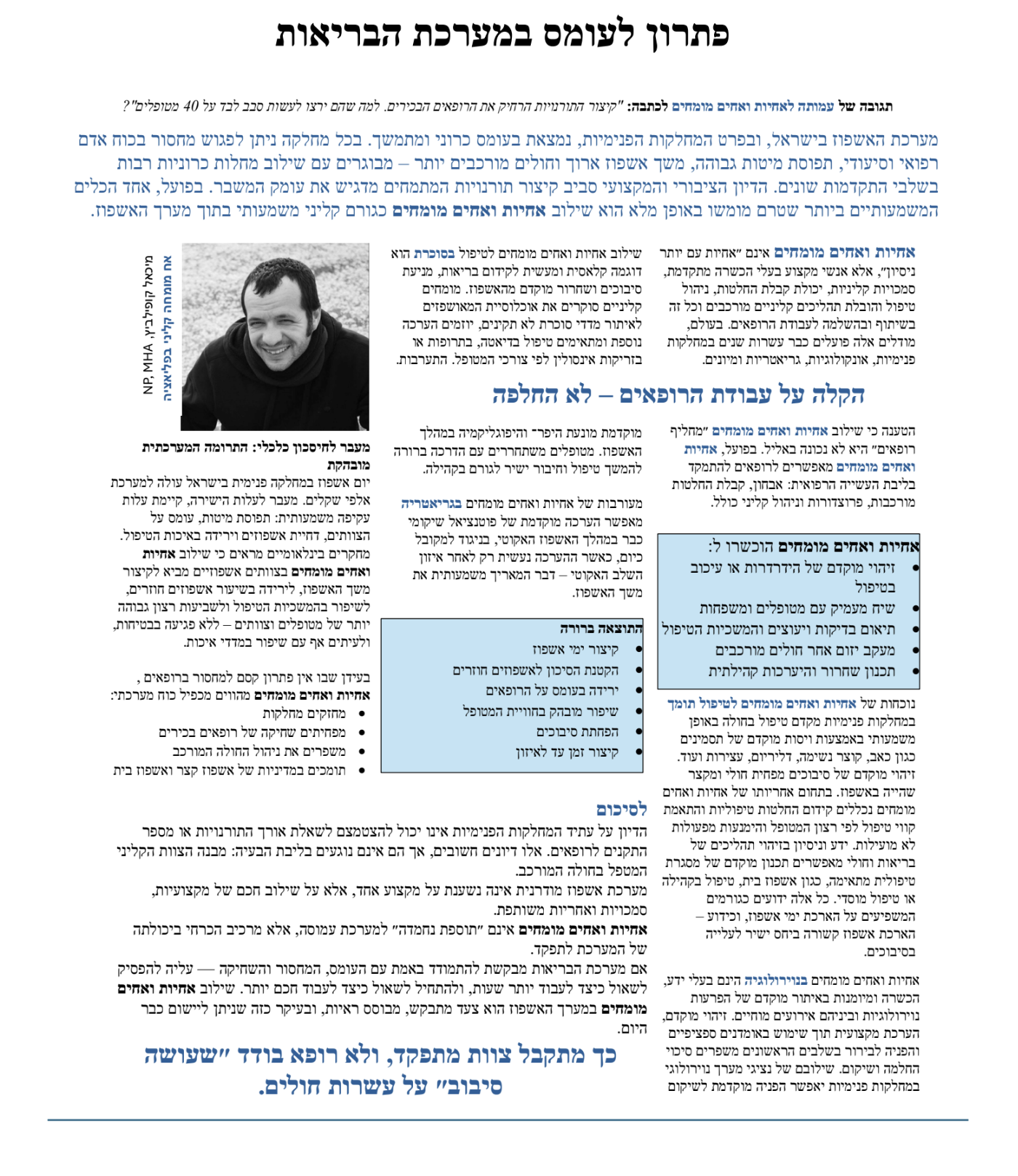
מצורף קישור לניוזלטר לדוגמא לצפייה .חברים הרשומים בארגון ( קישור להרשמה בתשלום למטה )
ישלחו הניוזלטרים הבאים למייל ויכנסו לרשימת התפוצה של העמותה .

נשמח לשמוע מכם!
השאירו פרטים בטופס ואדאג לחזור אליכם תוך 2 ימי עסקים
לשיחת ייעוץ ללא עלות וללא התחייבות.